
Freelancing vs. Full-Time Employment Early in Your Career

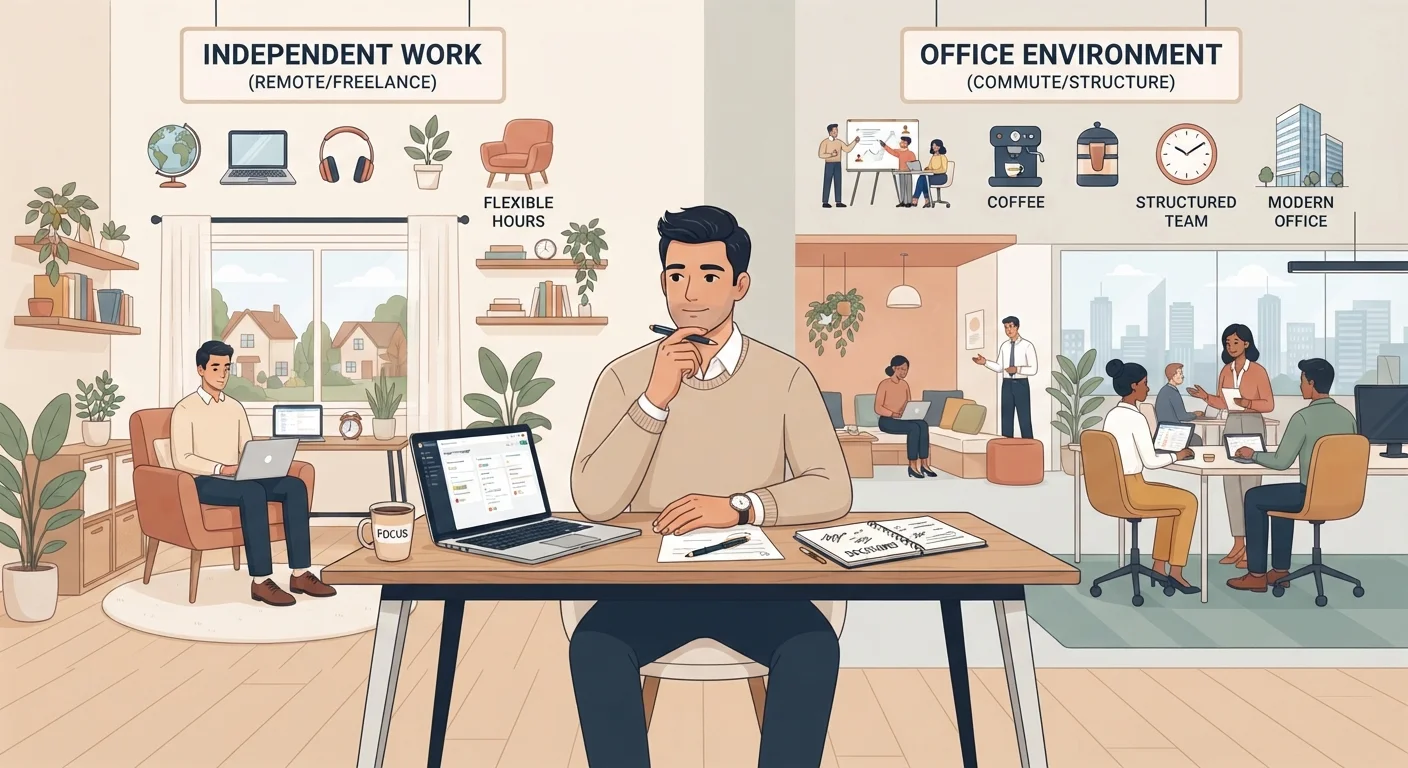
Photo: AnswersSquad.com | Explore Insightful Blogs editorial
Key Takeaways
- Full-time employment provides structured mentorship, benefits, and a predictable income that freelancing rarely offers early on.
- Freelancing builds a portfolio and business instincts quickly, but demands strong self-discipline and financial resilience.
- The right choice depends heavily on your field, existing skills, savings cushion, and tolerance for income uncertainty.
- Hybrid approaches - freelancing on the side while employed - can reduce risk while expanding experience.
- Financial planning matters more as a freelancer; irregular income requires a disciplined budgeting approach from day one.
Structured mentorship accelerates early skill development
Working alongside experienced colleagues provides daily feedback that self-directed freelancers rarely access. This compression of learning is especially valuable in the first 12-24 months of a career.
Predictable income supports financial planning
A regular paycheck makes budgeting, debt management, and savings goals significantly more manageable - an important factor when many early-career professionals are managing student loans or building an emergency fund.
Employer-sponsored benefits reduce personal overhead
Health insurance, retirement contributions, and paid leave have real monetary value that freelancers must fund independently, often at higher cost.
Employer brand and references build early credibility
A recognizable organization on your résumé signals baseline competence to future employers and clients - a form of social proof that a freelance portfolio, however strong, often takes longer to establish.
Built-in professional network through daily collaboration
Colleagues, managers, and cross-functional partners become part of a network that often generates future opportunities, referrals, and references over a career lifetime.
Income is irregular and can disappear without notice
Client work ebbs and flows, and early-career freelancers typically lack the reputation or network to fill gaps quickly. A slow month can become a serious financial problem without adequate savings.
No employer-sponsored benefits by default
Health coverage, retirement matching, and paid leave must be self-funded as a freelancer - adding real cost and administrative burden that full-time employees rarely consider.
Mentorship and feedback are largely absent
Without colleagues or managers providing daily guidance, skill gaps can go undetected or uncorrected for long periods, potentially slowing professional development.
Tax and administrative complexity adds overhead
Freelancers are responsible for quarterly estimated taxes, self-employment tax, invoicing, and recordkeeping - responsibilities that consume time and require financial literacy from the start.
Client acquisition is a skill that takes time to build
Finding and converting clients is a learned competency. Early-career freelancers often underestimate how long it takes to build a reliable client pipeline, particularly without an existing professional network.
Why This Decision Matters More Early On
The first two to three years of your career shape more than just your résumé - they build the professional instincts, habits, and relationships you'll rely on for decades. Choosing between freelancing and a salaried role during this window isn't just a lifestyle choice; it's a structural decision about how you learn, who teaches you, and how quickly you can build credibility in your field.
Unlike a career pivot made at 35, an early-career choice tends to define what kind of worker you become. That's not meant to create pressure - it's a reason to think carefully rather than default to whatever feels most exciting or most familiar. If you haven't yet mapped out what your chosen field actually requires day-to-day, the practical guide to researching careers before training is a useful starting point.
The Case for Full-Time Employment First
A salaried role gives early-career professionals something that's genuinely hard to manufacture on your own: structured, daily exposure to how competent people solve real problems. Mentorship, feedback loops, and cross-functional collaboration happen organically in most workplace environments - and they compress learning timelines in ways that self-directed freelance work often can't replicate.
Structured mentorship accelerates early skill development
Working alongside experienced colleagues provides daily feedback that self-directed freelancers rarely access. This compression of learning is especially valuable in the first 12-24 months of a career.
Predictable income supports financial planning
A regular paycheck makes budgeting, debt management, and savings goals significantly more manageable - an important factor when many early-career professionals are managing student loans or building an emergency fund.
Employer-sponsored benefits reduce personal overhead
Health insurance, retirement contributions, and paid leave have real monetary value that freelancers must fund independently, often at higher cost.
Employer brand and references build early credibility
A recognizable organization on your résumé signals baseline competence to future employers and clients - a form of social proof that a freelance portfolio, however strong, often takes longer to establish.
Built-in professional network through daily collaboration
Colleagues, managers, and cross-functional partners become part of a network that often generates future opportunities, referrals, and references over a career lifetime.
Beyond skills, full-time roles come with financial predictability. A consistent paycheck makes it far easier to build an emergency fund, manage student loan payments, and begin thinking about longer-term financial goals. If you're exploring the basics of managing money as your income grows, the Budgeting Basics hub offers practical frameworks worth reviewing.
There's also the credential question. In many fields - finance, engineering, law-adjacent roles, healthcare administration - employers use early work history as a proxy for baseline competence. A recognizable employer name or structured program on your résumé opens doors that a freelance portfolio, however impressive, sometimes can't.
The Case for Freelancing Early
Freelancing isn't inherently reckless at the start of a career - it can be a deliberate, high-growth choice in the right circumstances. If you already have a marketable skill (copywriting, web development, graphic design, video editing) and have built even a small network of potential clients, independent work can generate income and portfolio depth simultaneously.
Income is irregular and can disappear without notice
Client work ebbs and flows, and early-career freelancers typically lack the reputation or network to fill gaps quickly. A slow month can become a serious financial problem without adequate savings.
No employer-sponsored benefits by default
Health coverage, retirement matching, and paid leave must be self-funded as a freelancer - adding real cost and administrative burden that full-time employees rarely consider.
Mentorship and feedback are largely absent
Without colleagues or managers providing daily guidance, skill gaps can go undetected or uncorrected for long periods, potentially slowing professional development.
Tax and administrative complexity adds overhead
Freelancers are responsible for quarterly estimated taxes, self-employment tax, invoicing, and recordkeeping - responsibilities that consume time and require financial literacy from the start.
Client acquisition is a skill that takes time to build
Finding and converting clients is a learned competency. Early-career freelancers often underestimate how long it takes to build a reliable client pipeline, particularly without an existing professional network.
Freelancers also build business literacy quickly. Pricing work, managing client relationships, handling taxes, and marketing your services are skills that full-time employees rarely develop until much later - if at all. That breadth has real long-term value, particularly for anyone who eventually wants to run their own operation. The guide to self-directed professional development covers how to keep growing when there's no manager charting your path.
One practical middle path: take a full-time role while freelancing on the side. This approach builds experience in both modes without the financial exposure of going fully independent on day one.
~15%
US workforce engaged in freelance or independent work
According to the U.S. Bureau of Labor Statistics, roughly 15% of the workforce engages in some form of independent contracting or self-employment, with higher concentrations in creative and technology fields.
3-6 months
Recommended savings cushion before going fully independent
Personal finance educators broadly recommend maintaining three to six months of living expenses in reserve before leaving stable employment for fully self-directed work.
Key Factors to Weigh Before Deciding
No framework applies equally to every field or person. Use these dimensions to pressure-test your thinking:
- Skill readiness: Can you deliver work a client would pay for - today, without supervision? If the honest answer is no, structured employment will build that capability faster.
- Financial runway: Freelancing requires a cushion. Most advisers suggest three to six months of living expenses in reserve before going fully independent. Consider your current savings position honestly.
- Field norms: Some industries (tech, creative services) have robust freelance ecosystems. Others (corporate finance, clinical healthcare, regulated trades) are strongly structured around employed roles, especially at entry level.
- Portfolio vs. credential needs: If your field rewards demonstrated output - a body of published work, shipped code, completed designs - freelancing can build that portfolio quickly. If it rewards institutional credentials and employer lineage, a full-time path typically serves you better.
It's also worth reading how graduate schemes compare to direct applications if you're weighing more structured entry routes as an alternative.
This Is General Career Information, Not Personal Advice
The content provided on our blog site traverses numerous categories, offering readers valuable and practical information. Readers can use the editorial team’s research and data to gain more insights into their topics of interest. However, they are requested not to treat the articles as conclusive. The website team cannot be held responsible for differences in data or inaccuracies found across other platforms. Please also note that the site might also miss out on various schemes and offers available that the readers may find more beneficial than the ones we cover.