
Microlearning vs. Deep Study: Choosing the Right Approach for the Skill You Want

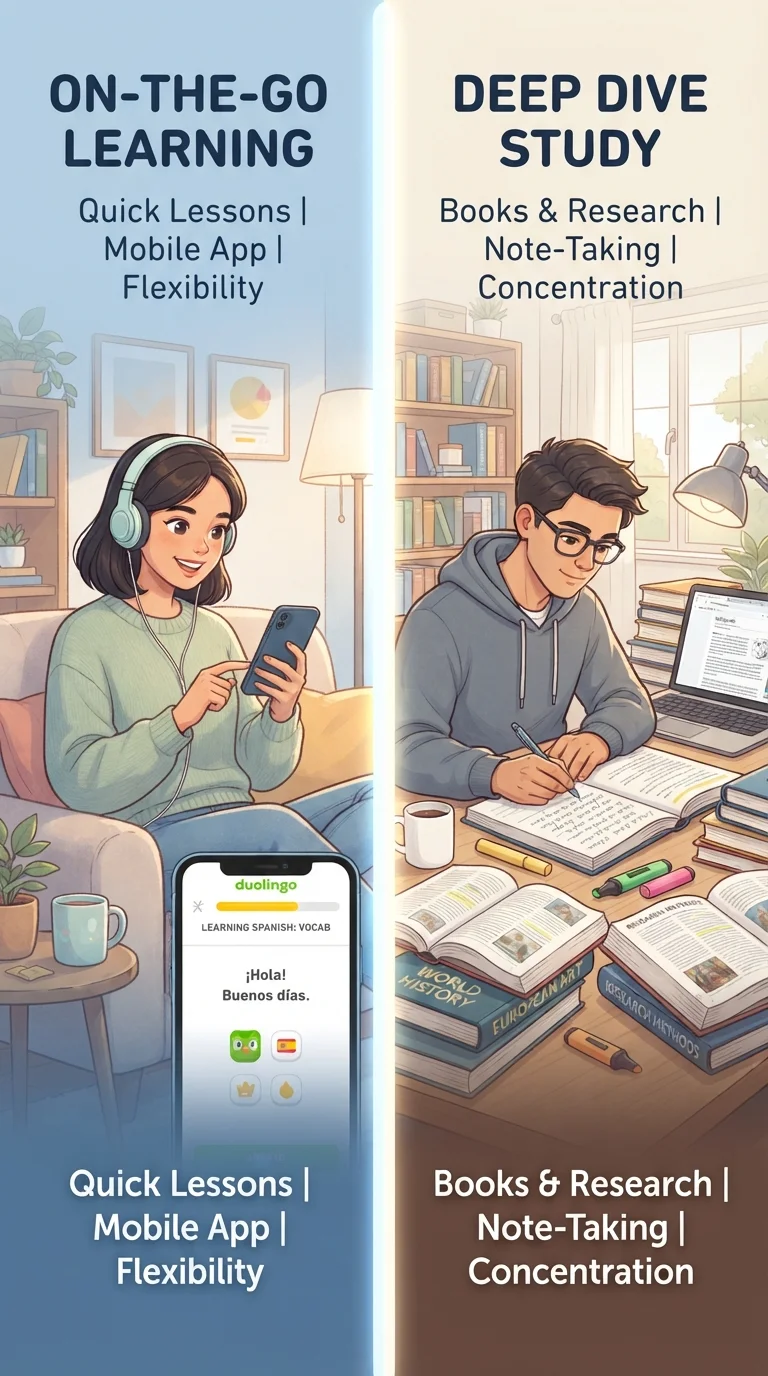
Photo: AnswersSquad.com | Explore Insightful Blogs editorial
Key Takeaways
- Microlearning suits awareness-level or habit-based skills; deep study is needed for complex, high-stakes competencies.
- The skill type—not personal preference—should drive which method you choose.
- Combining both approaches strategically often produces faster, more durable results than either alone.
- Time availability is a real constraint, but it shouldn't be the only factor guiding your learning method.
- Neither approach guarantees outcomes; consistency and quality of practice matter more than format.
What Each Approach Actually Means
Microlearning refers to consuming skill content in short, focused bursts—typically five to fifteen minutes. Think vocabulary flashcards, single-concept video lessons, or a quick coding exercise during a lunch break. The format is designed to fit into existing routines rather than requiring dedicated study time.
Deep study means extended, uninterrupted engagement with a subject—often an hour or more in a single session. It involves working through complex material, making connections between concepts, practicing with real problems, and tolerating productive confusion. It's the kind of learning that feels effortful, and that effort is part of what makes it effective for hard skills.
Both labels get used loosely online, which causes confusion. Microlearning is often marketed as a replacement for longer learning when it's better understood as a complement—or as the right tool for a specific job. Understanding the distinction helps you stop asking "which is better?" and start asking "which fits this skill?"
When Microlearning Is the Right Tool
Microlearning works well in situations where the knowledge gap is narrow, or where repetition and recall—rather than deep comprehension—drive progress. Strong use cases include:
- Language vocabulary: Spaced repetition in short daily sessions is well-supported by cognitive science as a method for retaining new words.
- Professional awareness skills: Staying current on industry trends, new regulations, or emerging tools benefits from frequent, short inputs rather than marathon reading sessions.
- Reinforcing already-learned concepts: Once you understand a principle, microlearning keeps it sharp without demanding large time blocks.
- Habit-formation skills: Skills like mindfulness, journaling, or physical warm-ups are built through daily micro-practice rather than intensive sessions.
If your schedule is genuinely constrained, microlearning also provides an accessible entry point. Even ten consistent minutes a day compounds meaningfully over months—a point explored further in our guide to building a learning habit that actually sticks.
Avoid Mistaking Familiarity for Mastery
When Deep Study Is Non-Negotiable
Some skills simply cannot be acquired in five-minute chunks, no matter how consistently you show up. Deep study becomes necessary when:
- The skill is structurally complex: Programming, statistics, financial modeling, and legal reasoning require learners to hold multiple ideas in working memory simultaneously. Short sessions interrupt that process before understanding can consolidate.
- You're building from scratch: Foundational knowledge in an unfamiliar domain requires enough context to be meaningful. Microlessons on machine learning mean little without a working understanding of mathematics and logic underneath.
- Certification or professional credentialing is involved: Exams and applied competency tests require the kind of fluency that only comes from sustained, rigorous practice. There's no shortcut to thinking through hard problems under pressure.
- You need to transfer the skill to novel situations: Real-world application—presenting to clients, debugging unfamiliar code, managing a project—requires flexible understanding, not just recall of isolated facts.
Worth noting: time invested doesn't automatically equal skill gained. See our related piece on deliberate practice and what makes study sessions actually effective for guidance on making deep-study blocks count.
| Microlearning | Deep Study | |
|---|---|---|
| Ideal session length | 5–15 minutes | 60–120+ minutes |
| Best for skill complexity | Low to moderate | Moderate to high |
| Requires dedicated time blocks | No — fits into existing routine | Yes — needs protected focus time |
| Supports foundational learning | Limited | Strong |
| Good for recall and reinforcement | Strong | Moderate |
| Suits credentialing or exam prep | Not on its own | Yes — essential |
| Risk of false progress | Higher — familiarity feels like mastery | Lower — struggle reveals real gaps |
Building a Hybrid Strategy That Works
For most skill goals, the most practical path is a deliberate combination. Here's how to structure it:
- Identify the skill tier. Is this a foundational skill you need to master, or a supplementary skill you need to be aware of? Mastery-level skills need deep study at their core; awareness-level skills may sustain on microlearning alone.
- Protect deep-study time first. Block one to three longer sessions per week for your primary skill. Treat these as fixed appointments. Microlearning fills the gaps—it doesn't replace the core sessions.
- Use microlearning for review, not discovery. Introduce new complex concepts during deep-study sessions, then reinforce them through short daily review using notes, flashcards, or practice problems.
- Reassess every four to six weeks. As you progress, the ratio shifts. Early in learning a complex skill, you need more deep study. As you build fluency, shorter maintenance sessions become more viable.
If you're deciding where to access structured learning, our overview of online learning platform formats can help you match a delivery method to your chosen approach. And for a broader view of how skill-building priorities evolve throughout a career, the complete guide to skill building across career stages offers useful framing.
The content provided on our blog site traverses numerous categories, offering readers valuable and practical information. Readers can use the editorial team’s research and data to gain more insights into their topics of interest. However, they are requested not to treat the articles as conclusive. The website team cannot be held responsible for differences in data or inaccuracies found across other platforms. Please also note that the site might also miss out on various schemes and offers available that the readers may find more beneficial than the ones we cover.