
The 50/30/20 Rule Explained

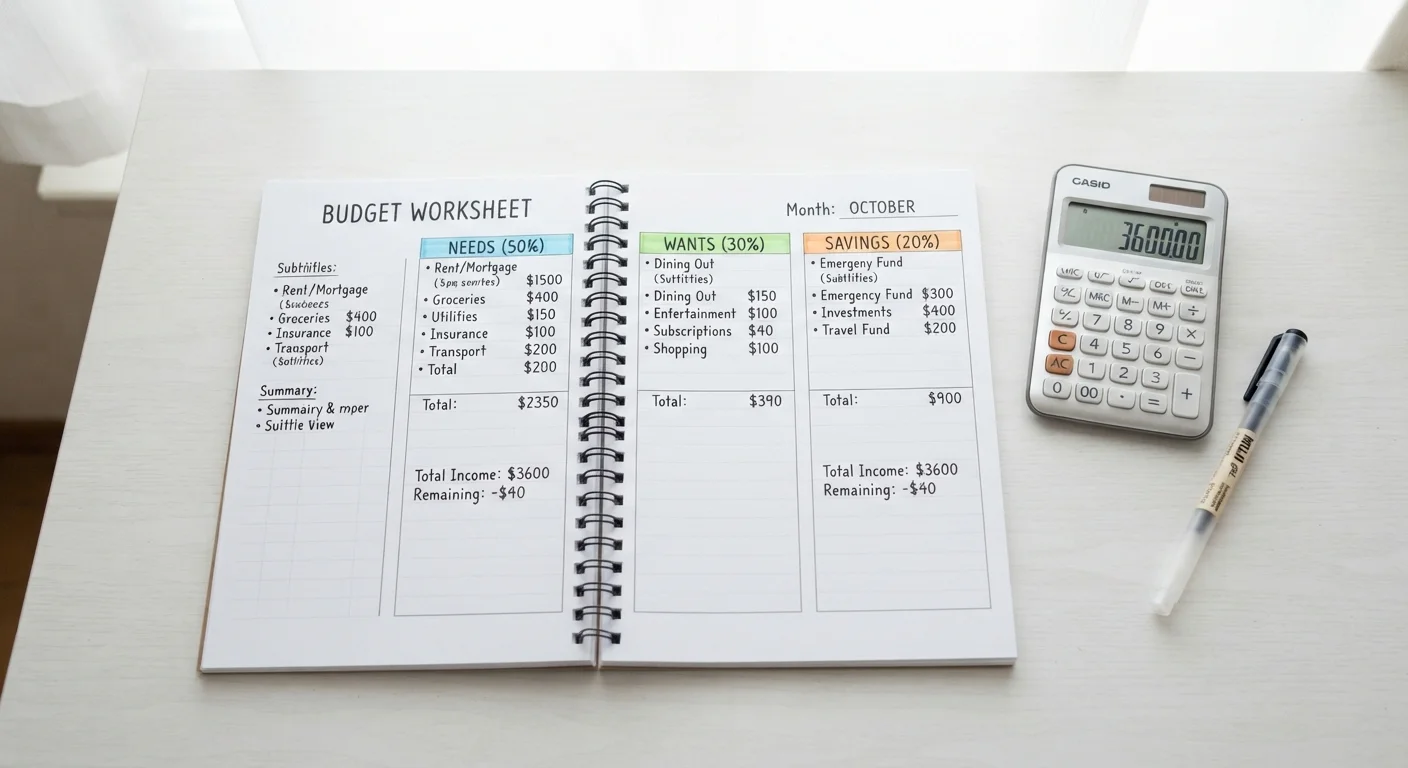
Photo: AnswersSquad.com | Explore Insightful Blogs editorial
Key Takeaways
- The 50/30/20 rule splits after-tax income into needs (50%), wants (30%), and savings/debt (20%).
- Needs are essentials you cannot reasonably cut; wants are upgrades or discretionary choices.
- The 20% savings bucket includes emergency funds, retirement contributions, and extra debt payments.
- The rule is a starting point — your actual percentages can and should be adjusted to fit your life.
- High-cost-of-living cities may require shifting the needs percentage higher temporarily.
- Pairing this framework with net worth tracking gives you a fuller picture of financial progress.
How the Three Buckets Actually Work
Start with your monthly take-home pay — everything deposited after taxes and any pre-tax deductions like a 401(k) contribution or health insurance premium. That number is your baseline. Then split it:
- 50% — Needs: Rent or mortgage, groceries, utilities, transportation (car payment plus gas, or a transit pass), health insurance out-of-pocket costs, and the minimum required payments on any debt.
- 30% — Wants: Everything discretionary — dining out, entertainment, travel, subscriptions, clothing beyond the basics, and anything that upgrades your life above the floor.
- 20% — Savings & debt repayment: Emergency fund contributions, retirement account deposits (like a Roth IRA or 401(k) beyond any employer match already deducted pre-tax), and extra debt payments above the minimums.
The most common misclassification is treating wants as needs. Your phone plan is a need; the premium unlimited data tier is a want. A used car payment may be a need; leasing a newer model is partially a want. The distinction matters because it's where budget drift most often happens.
34%
Americans with no monthly budget
A survey by the National Foundation for Credit Counseling found that roughly one-third of U.S. adults do not track their spending with any kind of budget.
$1,400
Median monthly rent, U.S. (recent estimates)
U.S. Census Bureau data indicates that median gross rent has risen substantially, making housing the single largest pressure point on the 50% needs bucket for renters.
20%
Recommended savings rate under this rule
Financial planning organizations, including those aligned with the CFP Board's general guidance, frequently cite 15–20% of income as a target savings rate for long-term financial health.
Putting Real Numbers to the Rule
Say your monthly after-tax income is $3,500. Here's what each bucket looks like in dollars:
| Category | Percentage | Monthly Amount |
|---|---|---|
| Needs | 50% | $1,750 |
| Wants | 30% | $1,050 |
| Savings & Debt | 20% | $700 |
If your rent alone is $1,400, that leaves only $350 for groceries, utilities, transportation, and minimum debt payments — a tight squeeze. That's not a failure of the rule; it's useful diagnostic information. It tells you that either your rent-to-income ratio is high and worth addressing over time, or that your needs percentage needs a temporary adjustment while you build income.
For a hands-on starting point, use the step-by-step budget builder to map your real numbers against these buckets before you decide whether to adjust them.
Automate the 20% First
Adapting the Rule When the Defaults Don't Fit
The 50/30/20 split is a starting point, not a mandate. Several situations legitimately call for adjustments:
- High cost-of-living areas: Housing alone can consume 40–45% of take-home pay in cities like New York or San Francisco. Scaling needs to 60% while trimming wants to 20% is a reasonable short-term move.
- Aggressive debt payoff goals: If you're targeting credit card or student loan payoff using an avalanche or snowball strategy, temporarily pushing the savings/debt bucket to 25–30% accelerates progress without breaking the overall structure.
- Variable income: Freelancers and gig workers should apply the rule to their lowest projected monthly income, then funnel any surplus months into savings before spending up to a higher wants figure.
The rule's real value is structural, not mathematical. It forces you to consciously assign every dollar a category and creates a visible signal when one area is crowding out another. Pair it with monthly check-ins — the monthly budget reset checklist can keep that habit under 30 minutes — and the framework compounds over time.
To see beyond monthly cash flow and understand whether the 20% savings bucket is actually moving your net worth forward, consider tracking net worth alongside your monthly budget. Cash flow and net worth together tell a much fuller story than either metric alone.
Frequently Asked Questions
The content provided on our blog site traverses numerous categories, offering readers valuable and practical information. Readers can use the editorial team’s research and data to gain more insights into their topics of interest. However, they are requested not to treat the articles as conclusive. The website team cannot be held responsible for differences in data or inaccuracies found across other platforms. Please also note that the site might also miss out on various schemes and offers available that the readers may find more beneficial than the ones we cover.