
Automating Your Savings: The Logic Behind Paying Yourself First

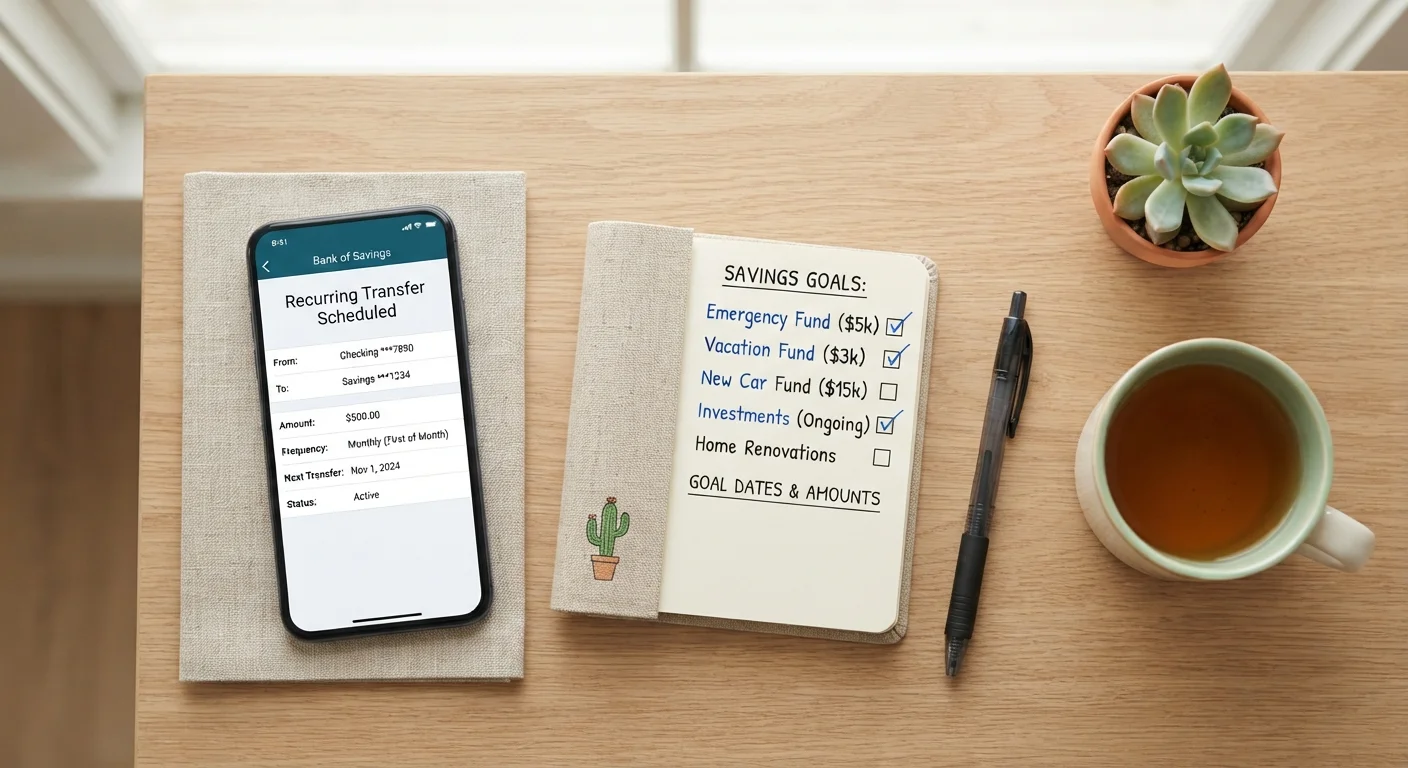
Photo: AnswersSquad.com | Explore Insightful Blogs editorial
Key Takeaways
- Automating savings removes willpower from the equation by making transfers happen before you can spend.
- Paying yourself first means directing money to savings immediately after each paycheck arrives.
- Even small recurring transfers compound meaningfully over time when started early.
- Setting up automated transfers typically takes under 30 minutes through your bank or employer.
- Separating savings into a dedicated account reduces the temptation to dip into it.
Why Automation Beats Willpower Every Time
Most savings advice boils down to "spend less, save more" — which is technically correct and practically useless. The problem isn't knowledge, it's friction. Every time saving requires a conscious decision, it competes with the immediate pull of spending. Automation eliminates that competition entirely.
Behavioral economists call this approach commitment devices — structures that lock in a future behavior before the moment of temptation arrives. When a transfer happens automatically two days after payday, your brain quickly recalibrates to the lower available balance as the new baseline. You adapt to what's there, not what was theoretically possible.
The timing matters enormously. As this analysis of early versus late saving explains, the gap between starting at 22 versus 32 isn't just one decade — it can mean the difference between doubling and quadrupling your ending balance, depending on the rate of return. Automation ensures you actually start, rather than waiting for the "right" amount to feel comfortable.
It's also worth understanding the habits that quietly work against you. The patterns that stall savings progress often aren't dramatic overspending — they're small, consistent leaks that automation can help plug by making saving non-negotiable.
This Is Education, Not Personal Financial Advice
What You Need and How to Set It Up
The setup is simpler than most people expect. You need two things: a source account (where your paycheck lands) and a destination account (where savings accumulate). The transfer connecting them does the rest.
What you will need
Below are the tools that make the setup work:
Online or Mobile Banking Portal
Used to schedule recurring transfers between your checking and savings accounts.
Employer Payroll Direct Deposit Form
Allows you to split your paycheck so a set amount goes directly into savings before it hits checking.
Dedicated Savings Account
A separate account for accumulated savings, ideally one that is not linked to a debit card to reduce temptation.
Keep Enough in Your Checking Account
Once the infrastructure is in place, follow the steps below. The process typically takes 15–30 minutes, and most of that is gathering your account numbers.
Calculate a realistic transfer amount
Review your last two or three months of take-home pay and fixed expenses — rent, utilities, subscriptions, loan payments. The gap between those fixed costs and your income is your working range. A widely used starting framework is the pay-yourself-first approach, which treats savings as a non-negotiable line item rather than what's left over.
A common starting target is 10–20% of take-home pay, but any consistent amount beats no amount. If 10% feels impossible right now, start lower and build from there.
Open a dedicated savings account if you don't already have one
Keeping savings in the same account as everyday spending dramatically increases the chance you'll absorb them. Open a separate savings account — ideally one without an attached debit card. A high-yield savings account (HYSA) is a common option that also earns interest on your balance, though rates vary and change over time.
The structural separation is the point: out of sight genuinely is out of mind when it comes to avoiding unplanned withdrawals.
Set up a recurring transfer through your bank
Log into your bank's online or mobile portal and look for a Transfers or Move Money section. Select your checking account as the source and your dedicated savings account as the destination. Set the amount and choose a frequency that matches your pay schedule — weekly, bi-weekly, or monthly. Schedule the transfer for one to two days after your typical payday so funds are available.
Save or screenshot the confirmation. Most banks send an email confirmation you can keep for reference.
Alternatively, split your direct deposit at the source
Many employers allow you to direct a fixed dollar amount or percentage of each paycheck to a second account. Ask your HR or payroll department for a direct deposit split form. Enter your savings account's routing and account numbers and specify how much should go there each pay period.
This approach is the most frictionless version of paying yourself first because the money never touches your checking account — it goes straight to savings before you see it.
Review and adjust after 60 days
After two months, check whether the transfer amount has caused any strain. Did you overdraft? Did you consistently end the month with unspent money? Adjust the amount up or down accordingly. The goal is to find a number that is genuinely automatic — not something you override manually each month.
As your income grows, revisit this number. A useful habit: any time you receive a raise or windfall, direct at least half of the increase to your automated savings before it gets absorbed into spending. Over time, see how compounding works in your favor by reviewing how compound interest builds long-term wealth.
Start Small, Then Scale Up
Once your automated savings are running, the logical next step is giving each dollar a purpose. The framework for structuring savings goals by timeline helps you organize what you're building toward — emergency fund, medium-term purchases, and long-term wealth — so automation has a clear destination, not just a holding pattern.
For a broader view on how this fits into your overall financial structure, the Budgeting Basics hub covers the full range of strategies that support a sustainable money plan.
This article is for general informational and educational purposes only and does not constitute personalised financial, investment, or tax advice. Consult a qualified financial professional regarding decisions specific to your circumstances.
The content provided on our blog site traverses numerous categories, offering readers valuable and practical information. Readers can use the editorial team’s research and data to gain more insights into their topics of interest. However, they are requested not to treat the articles as conclusive. The website team cannot be held responsible for differences in data or inaccuracies found across other platforms. Please also note that the site might also miss out on various schemes and offers available that the readers may find more beneficial than the ones we cover.