
Financing a Car vs Paying Cash: The Long-Term Cost Difference

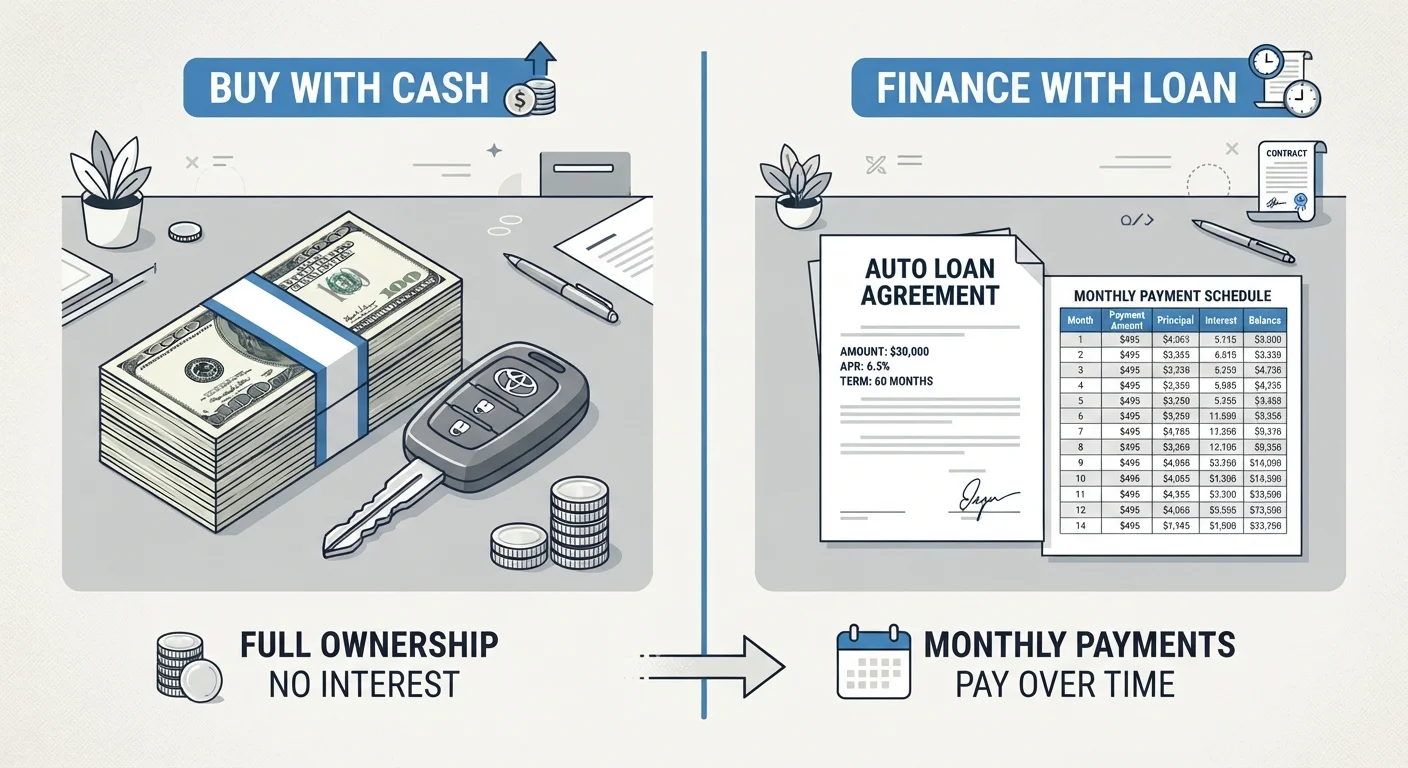
Photo: AnswersSquad.com | Explore Insightful Blogs editorial
Key Takeaways
- Financing a car always costs more in total than paying cash due to interest charges.
- Paying cash eliminates monthly obligations but reduces your available liquid savings.
- A car loan can help build credit history if managed responsibly.
- Opportunity cost matters - cash used for a car cannot be invested elsewhere.
- Neither option is universally better; the right choice depends on your financial situation.
Financing preserves your liquid cash reserves
Keeping cash available means you can handle emergencies, unexpected repairs, or other large expenses without going into further debt. Liquidity is a genuine financial asset.
A car loan can build your credit history
Consistently making on-time loan payments contributes positively to your credit profile over time, which can benefit you when applying for other credit in the future.
Cash payment eliminates all interest costs
Paying upfront means you spend only the purchase price - no APR, no loan fees, no interest accumulation over a multi-year term.
Cash buyers may have more negotiating leverage
A seller who doesn't need to wait on financing approval may be more willing to negotiate on price, though this isn't guaranteed in every transaction.
Financing allows you to invest remaining savings
If your loan rate is lower than your expected investment return, keeping cash working elsewhere may produce a net financial benefit - though investment returns are never guaranteed.
Financing always increases total amount paid
Interest charges mean you will pay more than the vehicle's purchase price, sometimes thousands of dollars more depending on the rate and loan term.
Monthly payments add to your budget obligations
A fixed monthly payment reduces your financial flexibility for years, which can feel constraining if your income changes or unexpected costs arise.
Paying cash reduces your liquid financial cushion
Large cash outlays can leave you with little buffer for emergencies, especially if the payment approaches or exceeds your available savings.
Longer loan terms dramatically increase interest paid
Stretching a loan to 72 or 84 months to lower monthly payments can more than double the interest cost compared to a shorter-term loan at the same rate.
What You're Actually Comparing
When you finance a car, a lender - a bank, credit union, or dealer-arranged lender - pays the seller upfront, and you repay that amount plus interest in monthly installments over a set term, typically 36 to 72 months. When you pay cash, you hand over the full purchase price yourself and owe nothing further.
The core trade-off is simple: financing costs more in total dollars spent, while cash preserves that cost but reduces the money you have available for other needs. Understanding the full scope of both options is essential before signing anything. For a broader view of everything a car will cost you, see the true cost of owning a car - purchase method is just one piece of a much larger picture.
The Real Cost of Financing
Interest is the price you pay for borrowing money. On a $25,000 auto loan at a 7% annual percentage rate (APR) over 60 months, you'd pay roughly $4,600 in interest over the life of the loan - meaning the car actually costs you closer to $29,600. A longer loan term lowers your monthly payment but increases total interest paid significantly.
$1,000-$5,000+
Typical interest paid on a standard auto loan
The exact figure varies based on loan amount, APR, and term length - shorter terms and lower rates reduce total interest significantly.
60-72 months
Most common new-car loan term in the US
Longer loan terms have become increasingly common, though they tend to increase total interest costs and the risk of owing more than the car is worth.
Your APR depends heavily on your credit score, loan term, and the lender you use. Buyers with strong credit typically access lower rates, while first-time borrowers or those with limited credit history may face higher ones. If you want to understand how lender types affect your rate, dealer financing vs. bank loans breaks down how each borrowing source works. For a deeper look at loan structures like Hire Purchase and Personal Contract Purchase, how car finance actually works explains each side by side.
The Hidden Trade-Off of Paying Cash
Paying cash eliminates interest entirely, and that's a genuine advantage. But it comes with its own cost: opportunity cost. That term refers to what you give up by choosing one use of money over another. If you spend $25,000 in cash on a car, that money is no longer available to sit in a high-yield savings account, contribute to a retirement account, or be invested in index funds.
Whether that trade-off makes sense depends on what return that money could realistically earn elsewhere, compared to the interest rate you'd pay on a loan. If a loan costs 4% APR and your savings consistently earn more than that, keeping the cash invested and financing the car could - in theory - leave you ahead. If loan rates are high and your savings earn little, paying cash is likely the financially stronger move. This isn't a guarantee of any outcome; it depends entirely on your personal rates and circumstances. For context on how saving and investing fits into these decisions, exploring the basics of growing savings early is worthwhile.
Don't Confuse a Low Payment with a Good Deal
One critical rule: never pay cash for a car if doing so leaves you without an emergency fund. Financial advisors generally recommend keeping three to six months of living expenses in liquid savings regardless of other financial goals. Draining your reserves for a vehicle purchase creates real financial vulnerability.
Pros and Cons at a Glance
Both approaches have legitimate advantages and clear disadvantages. How they weigh against each other depends on your interest rate, savings rate, credit goals, and financial cushion.
Financing preserves your liquid cash reserves
Keeping cash available means you can handle emergencies, unexpected repairs, or other large expenses without going into further debt. Liquidity is a genuine financial asset.
A car loan can build your credit history
Consistently making on-time loan payments contributes positively to your credit profile over time, which can benefit you when applying for other credit in the future.
Cash payment eliminates all interest costs
Paying upfront means you spend only the purchase price - no APR, no loan fees, no interest accumulation over a multi-year term.
Cash buyers may have more negotiating leverage
A seller who doesn't need to wait on financing approval may be more willing to negotiate on price, though this isn't guaranteed in every transaction.
Financing allows you to invest remaining savings
If your loan rate is lower than your expected investment return, keeping cash working elsewhere may produce a net financial benefit - though investment returns are never guaranteed.
Financing always increases total amount paid
Interest charges mean you will pay more than the vehicle's purchase price, sometimes thousands of dollars more depending on the rate and loan term.
Monthly payments add to your budget obligations
A fixed monthly payment reduces your financial flexibility for years, which can feel constraining if your income changes or unexpected costs arise.
Paying cash reduces your liquid financial cushion
Large cash outlays can leave you with little buffer for emergencies, especially if the payment approaches or exceeds your available savings.
Longer loan terms dramatically increase interest paid
Stretching a loan to 72 or 84 months to lower monthly payments can more than double the interest cost compared to a shorter-term loan at the same rate.
If you're carrying other high-interest debt, it's also worth considering how an auto loan fits into your overall debt picture. The debt avalanche vs. debt snowball frameworks can help you think through prioritization. And for broader financial context, the Credit & Debt hub covers building and managing debt responsibly.
This article provides general financial education and is not personalized financial advice. Consult a licensed financial professional for guidance specific to your circumstances.
The content provided on our blog site traverses numerous categories, offering readers valuable and practical information. Readers can use the editorial team’s research and data to gain more insights into their topics of interest. However, they are requested not to treat the articles as conclusive. The website team cannot be held responsible for differences in data or inaccuracies found across other platforms. Please also note that the site might also miss out on various schemes and offers available that the readers may find more beneficial than the ones we cover.