
Stress vs. Anxiety: How to Tell Them Apart

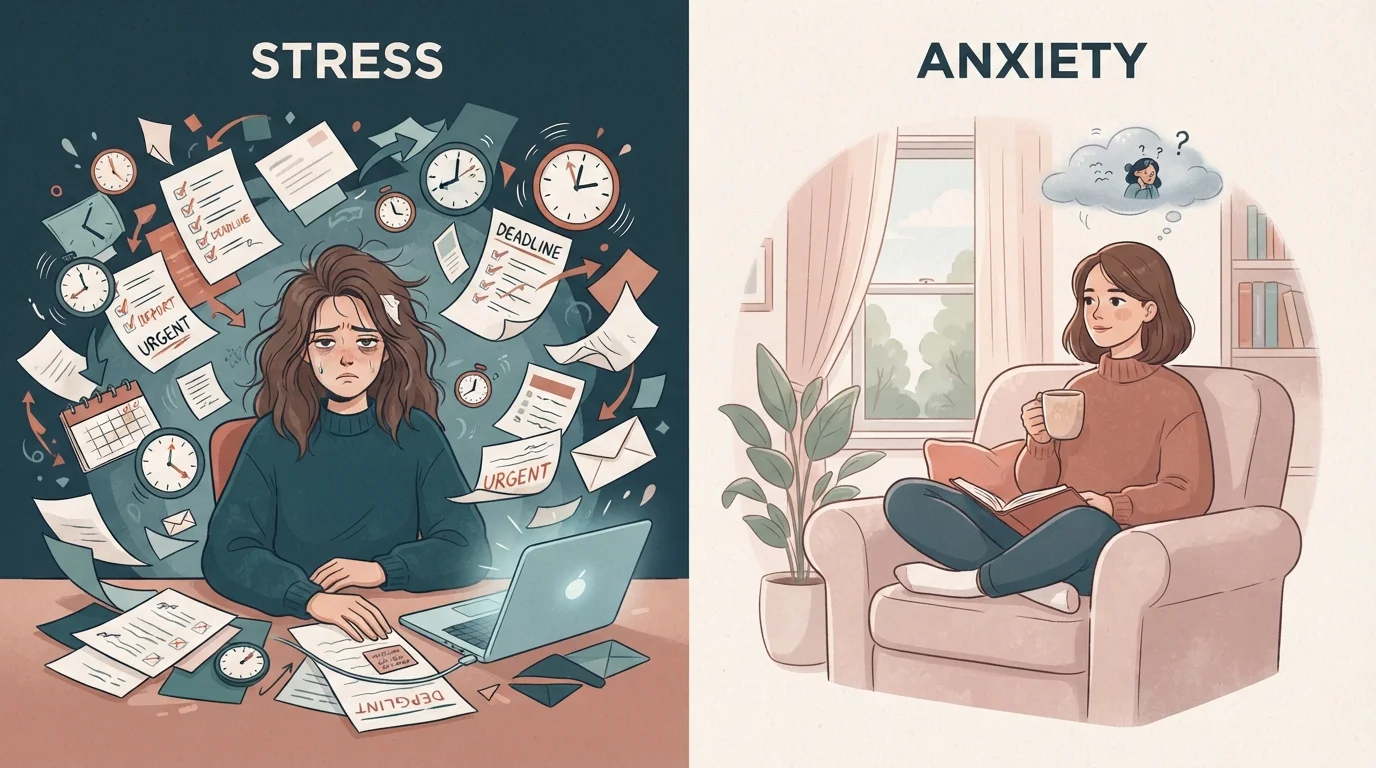
Photo: AnswersSquad.com | Explore Insightful Blogs editorial
Key Takeaways
- Stress is typically tied to a specific, identifiable external trigger and tends to ease when that trigger resolves.
- Anxiety often persists without a clear cause and can feel disproportionate to any actual threat.
- Both can produce similar physical symptoms, which is why they're easy to confuse.
- Telling them apart helps you choose more effective coping strategies.
- Anxiety that significantly disrupts daily life warrants a conversation with a qualified healthcare professional.
Why the Distinction Actually Matters
Stress and anxiety can feel nearly identical in the moment - racing heart, tight chest, trouble concentrating. That overlap makes it easy to use the words interchangeably. But they have meaningfully different origins and, as a result, respond to different approaches. Knowing which one you're dealing with is a genuinely useful first step, not just a semantic exercise.
This article is general health information - not a substitute for professional evaluation. If you're unsure what you're experiencing or it's affecting your daily life, talking to a qualified healthcare professional is always a reasonable move. For broader context on the spectrum of mental wellbeing, see our breakdown of mental health vs. mental illness.
| Criterion | Stress | Anxiety |
|---|---|---|
| Primary cause | External, identifiable trigger | Internal; often no clear trigger |
| Duration | Eases when trigger resolves | Persists beyond or without a trigger |
| Proportionality | Generally matches the situation | Can feel disproportionate to actual threat |
| Physical symptoms | Tension, fatigue, irritability | Similar, plus persistent restlessness |
| Response to resolution | Relief follows when problem is solved | Worry continues regardless |
| Helpful approaches | Problem-solving, rest, boundaries | Mindfulness, therapy, worry-interruption techniques |
What Stress Looks Like
Stress is a response to something external and usually identifiable. A work deadline, a difficult conversation, a financial crunch, a major life change - these are classic triggers. Your nervous system perceives a demand and mobilizes energy to meet it. That's actually what stress is designed to do.
The key feature of stress is that it's typically proportionate and time-limited. When the trigger resolves - the project is submitted, the conversation is had - the physical tension tends to follow. You feel relieved. That resolution is the clearest sign you were dealing with stress rather than something else.
Stress is also widely shared during life transitions like moving, changing jobs, or navigating new relationships. Our article on maintaining mental wellness during major life transitions covers strategies for staying grounded through that kind of pressure.
77%
Adults reporting physical stress symptoms
According to the American Psychological Association's Stress in America surveys, a large majority of adults regularly experience physical symptoms linked to stress.
31%
U.S. adults experiencing an anxiety disorder
The National Institute of Mental Health estimates that roughly 31% of U.S. adults will experience an anxiety disorder at some point in their lives.
What Anxiety Looks Like
Anxiety shares many of the same physical symptoms as stress - restlessness, muscle tension, difficulty sleeping, irritability. What separates it is the relationship to a trigger. Anxiety tends to persist even when no clear threat is present, or it shows up at a scale that feels out of proportion to what's actually happening.
Someone anxious about their health might not be able to name a specific symptom they're worried about. Someone with social anxiety might dread ordinary conversations in ways that don't resolve after the interaction ends. The worry takes on a life of its own, looping back regardless of circumstances.
It's worth noting that anxiety exists on a spectrum. Occasional anxious feelings are a normal part of being human. Clinical anxiety disorders - where symptoms are persistent, pervasive, and interfere with daily functioning - are a different category and are best evaluated by a professional. If you're noticing patterns that feel entrenched, our guide on signs that everyday stress may be worth discussing with a professional can help you gauge next steps.
Stress and Anxiety Can Coexist
Choosing the Right Response
Once you have a better sense of what you're experiencing, you can match your approach more deliberately. Stress often responds well to practical problem-solving: breaking the trigger into manageable steps, setting boundaries, or simply giving yourself permission to rest once the demand passes. Physical movement, sleep, and social connection help too.
Anxiety, because it isn't tied to a specific solvable problem, generally responds better to techniques that interrupt the worry loop itself - structured breathing, grounding exercises, mindfulness, or talking with a therapist. Cognitive behavioral approaches, in particular, have a well-established evidence base for anxiety. If you're considering professional support, understanding the difference between therapy, counselling, and coaching can help you figure out which type of help fits your situation.
Neither stress nor anxiety is a personal failing. They're signals from your nervous system. The goal isn't to eliminate them - it's to understand what they're telling you and respond in a way that actually helps.
This article is for general informational purposes only and does not constitute medical or mental health advice. Always consult a qualified healthcare professional for concerns about your personal mental health.
The content provided on our blog site traverses numerous categories, offering readers valuable and practical information. Readers can use the editorial team’s research and data to gain more insights into their topics of interest. However, they are requested not to treat the articles as conclusive. The website team cannot be held responsible for differences in data or inaccuracies found across other platforms. Please also note that the site might also miss out on various schemes and offers available that the readers may find more beneficial than the ones we cover.