
College, Trade School, or Self-Study: Mapping the Real Differences

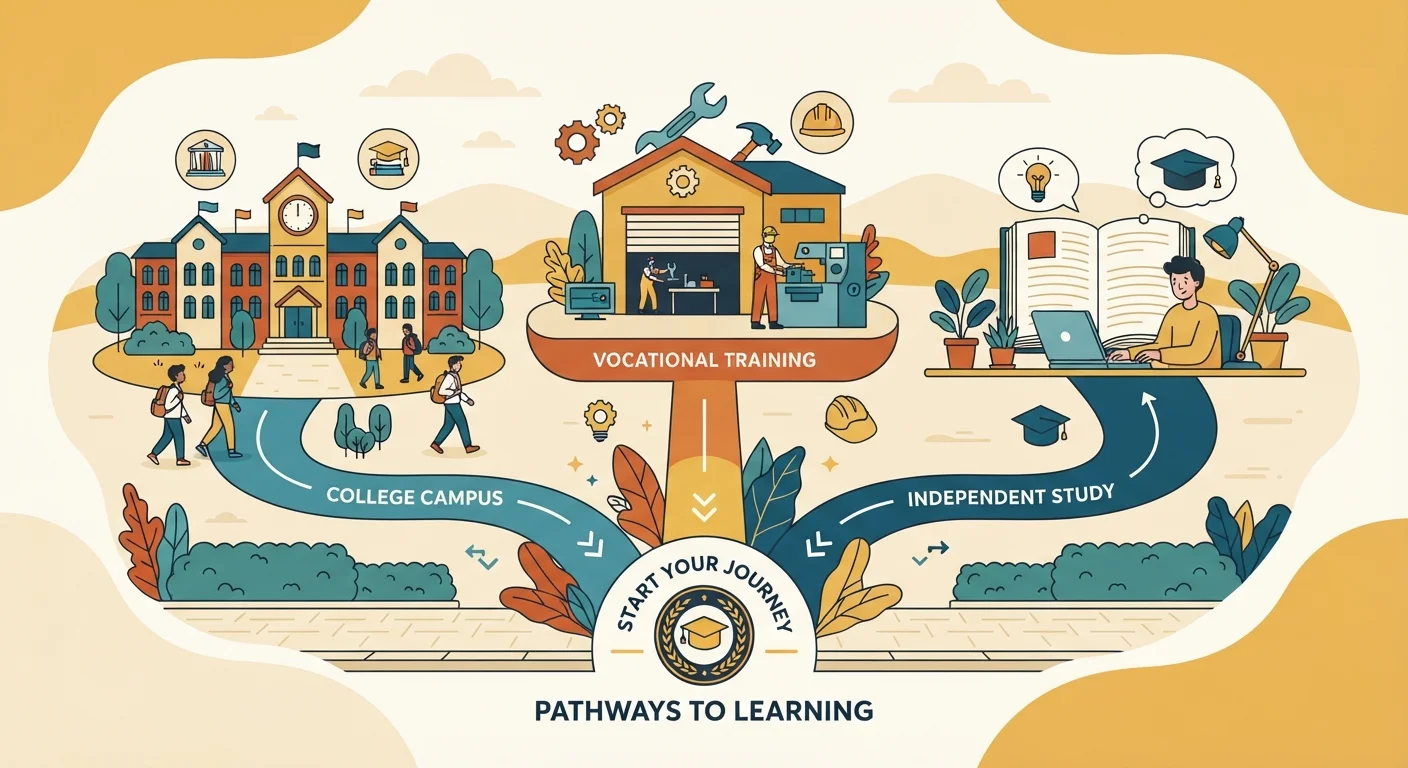
Photo: AnswersSquad.com | Explore Insightful Blogs editorial
Key Takeaways
- Four-year college delivers broad credentials but carries the highest cost and longest time commitment.
- Trade school programs typically run one to two years and lead directly into licensed, in-demand careers.
- Self-study is the most affordable path but requires strong self-discipline and may lack employer recognition in credentialed fields.
- The right path depends on your target career, financial situation, and how you learn best.
- Hybrid approaches - such as community college plus self-study - are increasingly viable and worth exploring.
Why the Path You Choose Matters More Than Ever
Education decisions have always been consequential, but they carry more weight today when tuition costs have risen sharply, labor markets shift quickly, and employers increasingly care about demonstrated skills alongside formal credentials. Understanding what each major pathway actually delivers - and what it costs you in time, money, and opportunity - is essential before enrolling anywhere.
This comparison covers the three most common routes young adults navigate: a four-year college degree, a vocational or trade school program, and structured self-study. For a broader map of all available routes, see Education Pathways: A Complete Map for Young Adults.
| Four-Year College | Trade School | Self-Study | |
|---|---|---|---|
| Typical duration | 4 years | 1-2 years | Variable (months to years) |
| Average cost (US) | High (tuition + living costs) | Moderate | Low to minimal |
| Credential awarded | Bachelor's degree | Certificate or associate degree | None, or third-party certificate |
| Employer recognition | Broadly recognized | Recognized in relevant trades | Field-dependent; portfolio-based |
| Career flexibility | High across many industries | Moderate within trade cluster | High in portfolio-driven fields |
| Licensing eligibility | Required for many professions | Required for most trade licenses | Generally not sufficient |
| Time to first job | 4+ years | 1-2 years | Months (if portfolio-ready) |
| Structure and accountability | High (scheduled curriculum) | High (structured program) | Low (self-directed) |
Four-Year College: Breadth, Credentials, and Cost
A bachelor's degree remains the entry requirement for many professional fields - nursing, engineering, social work, education, and law among them. Beyond specific careers, college provides transferable analytical skills, a professional network, and a credential that signals completion to a broad range of employers.
The trade-offs are real. Average annual tuition at a public four-year university runs into the tens of thousands of dollars before housing and living costs, and student loan debt is a genuine long-term burden for many graduates. Time is also a factor: four years of full-time study is four years of deferred income. That said, median earnings for bachelor's degree holders remain meaningfully higher over a lifetime than for those without one, according to Bureau of Labor Statistics data - though that average masks wide variation by field and institution.
For a closer look at what a degree actually costs beyond tuition, see The Real Cost of a Four-Year Degree: Beyond Tuition. If you're weighing an online format, Online Degrees vs. On-Campus Study offers a research-grounded comparison.
Research the Job Before Choosing the Training
Trade School: Speed, Focus, and Earning Power
Vocational and trade school programs typically run one to two years, focus on a specific skill set, and feed directly into licensed trades: electricians, HVAC technicians, welders, dental hygienists, and medical assistants, among others. Tuition is considerably lower than a four-year degree, and graduates often enter the workforce before their college-track peers finish their sophomore year.
Skilled trades are experiencing strong demand in the US, and many trade careers offer stable employment, union protections, and wages that compare favorably with those of college graduates in lower-paying degree fields. The limitation is specificity: a trade credential trains you for one occupational cluster, and pivoting to a field outside that cluster typically requires additional training.
For a detailed earnings comparison between vocational and university paths, see Trade School vs. University: Weighing Long-Term Returns.
Self-Study: Flexibility, Low Cost, and Credibility Gaps
Independent learning - through online courses, open courseware, books, tutorials, and project work - has never been more accessible or more capable of producing real skills. In fields where employers evaluate candidates on demonstrated output (software development, graphic design, data analysis, content creation, and others), a strong portfolio built through self-study can be genuinely competitive.
The core challenges are structure and recognition. Self-study demands consistent self-motivation, and without external deadlines it is easy to stall. In licensed or regulated fields, self-study cannot substitute for accredited credentials regardless of skill level. Employers in traditional sectors often still screen by credential at the application stage, meaning self-taught candidates may not pass initial filters even when highly capable.
Research on hiring outcomes for self-taught versus formally trained candidates is nuanced - see Self-Taught vs. Formally Trained: What the Research Actually Says About Hiring for a detailed breakdown. For help choosing the right learning format, Online Learning Platforms Compared is a practical starting point.
Choosing the Right Path: Questions Worth Asking First
Before committing to any pathway, ground your decision in research about your target career rather than general assumptions. Ask what credentials employers in that field actually require, what the typical salary range is, and how long the career takes to enter. These answers vary dramatically by occupation.
Also consider your financial situation honestly. Taking on significant debt for a degree in a low-earning field is a different risk profile than doing the same for a high-demand profession. Budgeting for your education costs is a practical step many students skip - Budgeting Basics can help you build a realistic picture.
Community college is worth naming here as an often-overlooked middle path: lower tuition, transferable credits, and flexible scheduling make it suitable for a wide range of situations. See What a Community College Actually Offers for a fuller picture. Whatever route you're considering, use the pre-enrollment checklist to vet your choice before signing anything.
The content provided on our blog site traverses numerous categories, offering readers valuable and practical information. Readers can use the editorial team’s research and data to gain more insights into their topics of interest. However, they are requested not to treat the articles as conclusive. The website team cannot be held responsible for differences in data or inaccuracies found across other platforms. Please also note that the site might also miss out on various schemes and offers available that the readers may find more beneficial than the ones we cover.