
Index Funds, ETFs, and Mutual Funds: A Plain-Language Breakdown

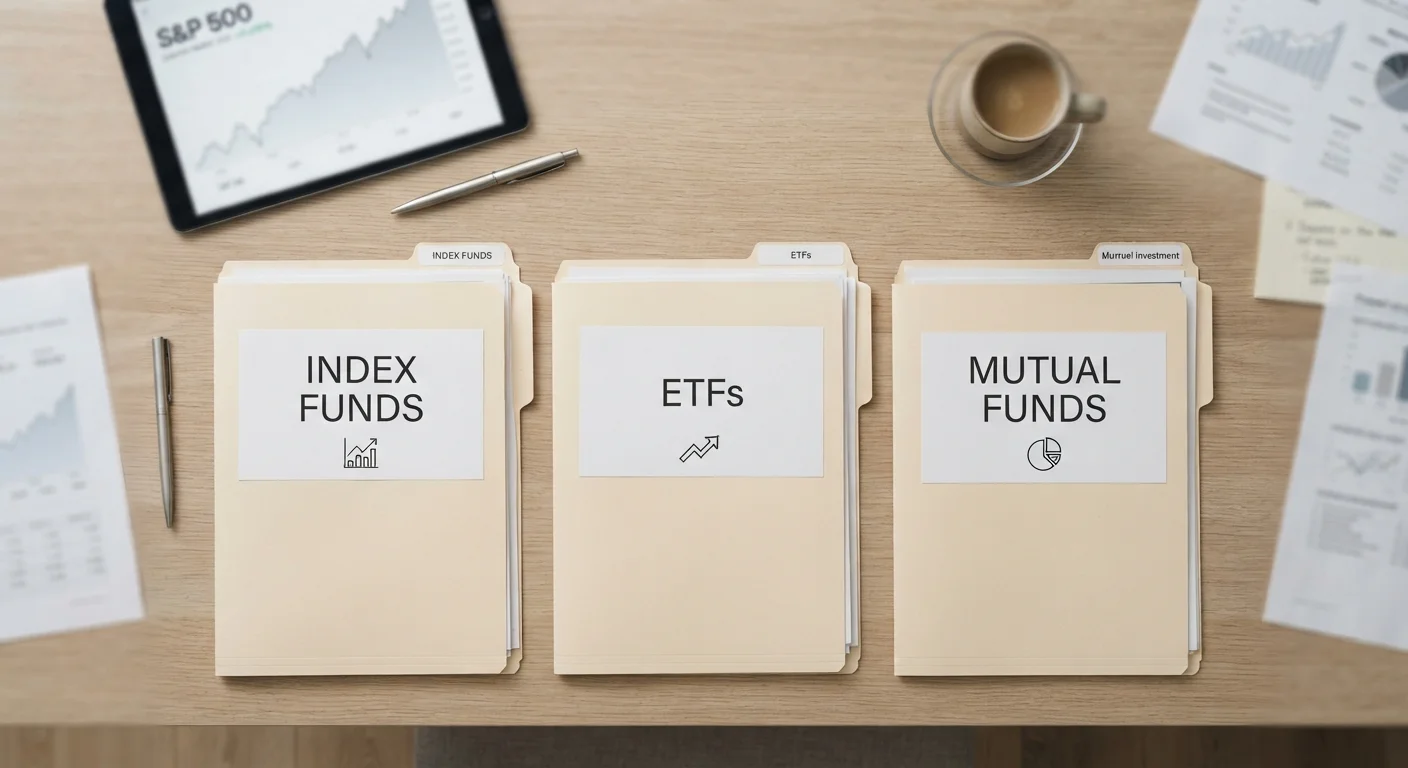
Photo: AnswersSquad.com | Explore Insightful Blogs editorial
Key Takeaways
- Index funds and ETFs both track market indexes passively; mutual funds may be actively or passively managed.
- ETFs trade throughout the day like stocks; index funds and mutual funds price once daily after market close.
- Lower expense ratios — the annual fee charged as a percentage of your investment — mean more of your money stays invested.
- All three carry market risk; there are no guaranteed returns in any investment vehicle.
- Consult a licensed financial adviser before making decisions based on your specific situation.
What These Three Vehicles Actually Are
Before comparing them, it helps to understand what each one does at a basic level. If you're new to some of the terminology, the financial terms glossary covers the foundational vocabulary you'll need.
Index Funds
An index fund is a type of investment fund designed to mirror the performance of a specific market index — the S&P 500, for example. Instead of a manager picking individual stocks, the fund simply holds the same securities in the same proportions as the index it tracks. This is called passive management. You buy shares at the end of each trading day at the fund's net asset value (NAV).
ETFs (Exchange-Traded Funds)
ETFs work similarly to index funds in that most track an index passively — but they trade on stock exchanges throughout the day, just like individual stocks. This means the price fluctuates during market hours rather than settling once at day's end. Many ETFs have no minimum purchase requirement beyond the price of a single share, and some brokerages now offer fractional shares.
Mutual Funds
Mutual funds pool money from many investors to buy a portfolio of securities. They can be either passively managed (tracking an index) or actively managed, where a portfolio manager makes ongoing decisions about what to buy and sell. Actively managed mutual funds typically carry higher fees to pay for that management. Like index funds, mutual funds price once daily after market close.
How They Compare: Costs, Flexibility, and Access
Cost is one of the clearest differentiators. The key metric to watch is the expense ratio — the annual percentage of your investment charged as a management fee. Passive index funds and ETFs typically carry expense ratios well below 0.20%, while actively managed mutual funds can range from 0.50% to over 1.00%. On a $10,000 investment held for 20 years, that difference compounds significantly.
| Index Funds | ETFs | Actively Managed Mutual Funds | |
|---|---|---|---|
| Management style | Passive | Mostly passive | Active (manager-directed) |
| Typical expense ratio | Under 0.20% | Under 0.20% | 0.50%–1.00%+ |
| Trading frequency | Once daily (NAV) | Throughout the day | Once daily (NAV) |
| Minimum investment | Varies; often $0–$1,000 | One share (or fractional) | Often $500–$3,000+ |
| Best for automation | Yes — easy to automate | Yes, with some brokerages | Yes — easy to automate |
| Tax efficiency | Generally high | Generally highest | Lower (more turnover) |
Trading flexibility matters less for long-term investors on a set contribution schedule, but it's worth understanding. ETFs offer intraday pricing, which appeals to investors who want more control over their entry price. Index funds and mutual funds suit people who prefer to automate contributions without worrying about timing.
Minimum investments also vary. Some mutual funds require $1,000 or more to open a position, while many ETFs can be started with the price of a single share — or less, with fractional share programs.
Passive vs. Active: The Decision Underneath the Labels
The deeper question isn't really "ETF or mutual fund" — it's passive vs. active management. Index funds and most ETFs are passive: they aim to match a market index, not beat it. Most actively managed mutual funds aim to outperform the market, though decades of data from sources like S&P's SPIVA reports consistently show that a large majority of active funds underperform their benchmark index over long periods, especially after fees.
Check the Expense Ratio First
That doesn't mean active management is never appropriate — some investors use it for specific asset classes or strategies — but for beginners building a long-term portfolio, passive, low-cost vehicles have a strong track record as a starting point. The beginner's investing guide explores how to think about this choice in the context of broader portfolio building.
Pairing any of these vehicles with a strategy like dollar-cost averaging — investing a fixed amount on a regular schedule regardless of market conditions — can reduce the emotional pressure of trying to time your entries.
Before You Choose: Foundational Considerations
Selecting between these three vehicles is a secondary decision. The primary one is whether you're financially ready to invest at all. The emergency fund vs. investment account comparison is a useful starting point if you're weighing whether to invest before you have a financial cushion in place.
Once you've confirmed your readiness — including having adequate liquid savings and manageable high-interest debt — the investment account readiness checklist can walk you through what to verify before committing money.
~85%
Active large-cap funds underperforming benchmark
According to S&P's SPIVA U.S. Scorecard, roughly 85% of actively managed large-cap funds underperformed the S&P 500 over a 15-year period.
0.06%
Average expense ratio for index ETFs
Morningstar's annual fee study has reported average asset-weighted expense ratios for passive index ETFs around 0.06%, compared to over 0.60% for active funds.
When you are ready to choose, consider: What account type will you use (taxable brokerage, IRA, Roth IRA)? Does your brokerage offer commission-free ETF or index fund trading? Are you comfortable with daily price fluctuations, or do you prefer to set contributions and ignore the noise? These practical questions will often narrow your choice faster than abstract comparisons.
This article is for general informational and educational purposes only. It does not constitute personalised investment, financial, tax, or legal advice. All investments carry risk, including the potential loss of principal. Past performance does not guarantee future results. Consult a qualified, licensed financial adviser for guidance specific to your circumstances.
The content provided on our blog site traverses numerous categories, offering readers valuable and practical information. Readers can use the editorial team’s research and data to gain more insights into their topics of interest. However, they are requested not to treat the articles as conclusive. The website team cannot be held responsible for differences in data or inaccuracies found across other platforms. Please also note that the site might also miss out on various schemes and offers available that the readers may find more beneficial than the ones we cover.