
Solid Wood, Engineered Wood, and MDF: What Sets Them Apart

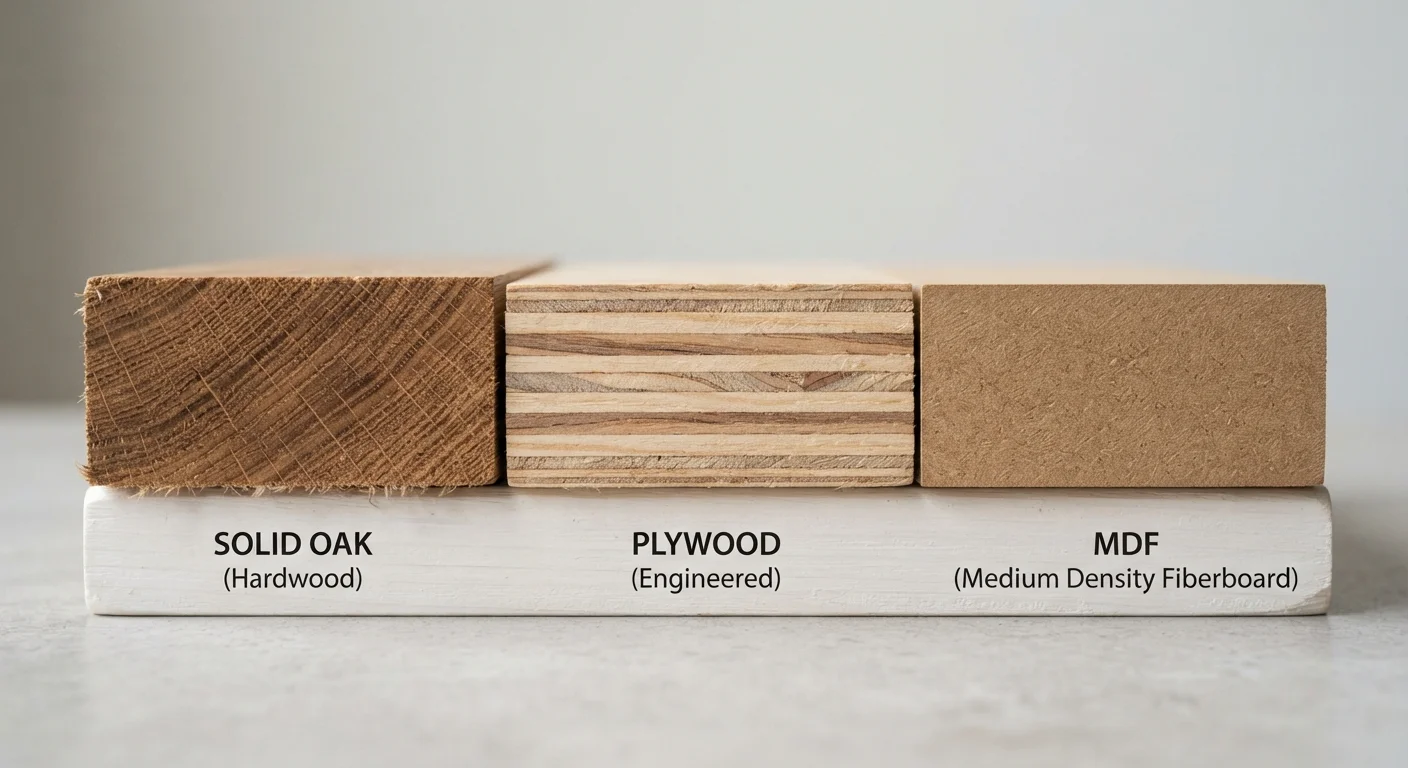
Photo: AnswersSquad.com | Explore Insightful Blogs editorial
Why the Material Label Actually Matters
Walk through any furniture store or scroll any product listing and you'll see the same three terms repeated: solid wood, engineered wood, and MDF. These aren't interchangeable. Each material behaves differently over time, reacts differently to moisture and weight, and comes with its own cost profile. If you're furnishing a first apartment or a starter home, knowing what's behind the label can save you from a costly mismatch.
This isn't about which material is "best" - it's about which is right for a given situation. A bookcase in a dry living room has different needs than a bathroom vanity or a heavily used dining table. Starting from scratch with empty rooms is already overwhelming; let this be your material cheat sheet.
| Solid Wood Refinishable | Yes - can be sanded and restained multiple times |
| MDF Moisture Resistance | Low - swells and bubbles when wet |
| Plywood Strength-to-Weight | High - cross-grain layers resist warping and stress |
| Particleboard Common Use | Budget flat-pack furniture and shelving |
| Best Material for Paint Finish | MDF - extremely smooth and consistent surface |
| Humidity Risk | Highest for MDF and particleboard; manageable for sealed solid wood |
Solid Wood: What You're Actually Getting
Solid wood is milled directly from a tree trunk or large branches - the piece you see is the same material all the way through. Common species used in furniture include oak, pine, maple, and walnut. Because there's no adhesive or composite core, solid wood can be sanded and refinished multiple times, which is why antique solid-wood furniture still holds up after decades.
The trade-offs are real, though. Solid wood expands and contracts with humidity changes. In a dry apartment with forced-air heat in winter, a solid-wood tabletop can crack or warp if it isn't properly sealed and maintained. It also tends to carry a higher price tag than the alternatives - though that cost reflects genuine longevity when the piece is well-made and well-cared-for.
When shopping secondhand, solid wood is generally one of the safer bets. Evaluating used furniture is much easier when the material is solid wood - you can spot surface damage, check for structural soundness, and know that refinishing is an option.
Engineered Wood: Layers with a Purpose
Engineered wood is an umbrella term for several manufactured panel products built from wood layers bonded with adhesive under heat and pressure. The most common types you'll encounter in furniture are:
- Plywood: Thin wood veneers glued in alternating grain directions. This cross-grain construction makes plywood surprisingly strong and resistant to warping - often stronger than solid wood of the same thickness for certain applications.
- Particleboard: Wood chips and sawdust compressed with resin. It's heavier and less moisture-resistant than plywood, but widely used in budget furniture because it's inexpensive to produce.
- LVL (Laminated Veneer Lumber): Veneers layered with consistent grain direction, used more in structural applications than decorative furniture.
Much flat-pack furniture uses particleboard with a veneer or laminate surface. That surface finish can look like real wood, but it can't be sanded down if damaged. Flat-pack furniture carries real trade-offs worth understanding before you buy.
Solid Wood
Lumber cut directly from a tree and used as a single, continuous piece of material. It can be sanded and refinished, but it responds to humidity changes by expanding and contracting.
Engineered Wood
A category of manufactured wood products made by bonding wood fibers, veneers, or particles with adhesive. Includes plywood, particleboard, and MDF. Properties vary significantly by type.
MDF (Medium-Density Fiberboard)
A dense, smooth panel made from fine wood fibers and resin. Excellent for painted surfaces but vulnerable to moisture and less effective at holding screws than solid wood or plywood.
Particleboard
An engineered wood panel made from compressed wood chips and resin. It is inexpensive and widely used in budget furniture, but it is heavier and less moisture-resistant than plywood.
Plywood
Engineered wood made from thin wood veneers glued together in alternating grain directions. The cross-grain construction makes it strong, stable, and more moisture-tolerant than particleboard or MDF.
Veneer
A thin slice of real wood - or a printed surface that mimics wood - applied over an engineered wood core. Adds the appearance of solid wood at a lower cost, but cannot be sanded down like solid wood.
MDF: Dense, Smooth, and Specific
MDF (Medium-Density Fiberboard) is made from fine wood fibers - much smaller than the chips in particleboard - bound with resin and compressed into dense, uniform panels. Because the surface is so smooth and consistent, MDF takes paint exceptionally well, which is why it's common in cabinet doors, trim, and painted furniture.
MDF is heavier than most people expect. It doesn't hold screws as reliably as solid wood or plywood, especially at edges, which is why furniture quality often comes down to how pieces are joined - not just the panel itself. It's also notably vulnerable to moisture: swelling and surface bubbling are permanent once they occur.
For painted shelving, media consoles, or decorative pieces in a controlled indoor environment, MDF can perform well at a lower cost. For anything near a bathroom, kitchen sink, or damp basement, it's worth choosing an alternative. Brushing up on furniture shopping terminology will help you decode what you're reading on spec sheets and labels.
Choosing the Right Material for Your Situation
No single material wins every scenario. Here's a practical frame for making the call:
- High-use surfaces (dining tables, desks): Solid wood or quality plywood will hold up better to daily contact, spills, and weight stress.
- Painted cabinetry and built-ins: MDF delivers a flawless finish that's harder to achieve on natural wood grain.
- Budget shelving in a dry room: Particleboard with laminate works fine if loads are light and moisture isn't a factor.
- Humidity-prone spaces (bathrooms, laundry rooms): Avoid MDF and particleboard; look for solid wood with proper sealing, or moisture-rated plywood.
When you're comparing pieces at similar price points, the material is often what explains the difference. A labeled "wood" piece might be particleboard with a thin veneer, while another labeled "engineered wood" might be high-grade plywood. Reading the full product description - and asking questions when buying in-person - matters more than the headline label. Matching condition to context is equally relevant here: a well-made secondhand solid-wood dresser may outlast a new MDF alternative by years.
The content provided on our blog site traverses numerous categories, offering readers valuable and practical information. Readers can use the editorial team’s research and data to gain more insights into their topics of interest. However, they are requested not to treat the articles as conclusive. The website team cannot be held responsible for differences in data or inaccuracies found across other platforms. Please also note that the site might also miss out on various schemes and offers available that the readers may find more beneficial than the ones we cover.